

Retrofitting Services: Structural Warning Signs You Shouldn’t Ignore
Every structure is designed with a specific service life. However, prolonged exposure to environmental conditions, increased operational demands, ageing materials, design limitations, and changing regulatory requirements can gradually reduce its structural performance. What often begins as a minor crack, localized corrosion, or water ingress can eventually develop into significant structural distress if left unaddressed.
Professional Retrofitting Services provide engineered solutions to restore structural integrity, enhance load-carrying capacity, improve seismic performance, and extend the operational life of existing buildings without the cost and disruption associated with demolition and reconstruction.
For industrial facilities, commercial buildings, institutional campuses, residential complexes, warehouses, manufacturing plants, and public infrastructure, early identification of structural deterioration is essential for maintaining safety, operational continuity, and asset value.
This article outlines the most common indicators that suggest your structure requires professional structural assessment and retrofitting.
1. Progressive Structural Cracking
Structural cracks are among the earliest and most visible indicators of deterioration. While hairline shrinkage cracks may be non-structural, recurring or widening cracks in load-bearing members require immediate engineering evaluation.
Critical warning signs include:
- Diagonal shear cracks in beams and columns
- Flexural cracks in slabs
- Cracks at beam-column junctions
- Settlement cracks
- Foundation-related cracking
- Widening cracks with visible movement
These defects may indicate overstressing, reinforcement corrosion, differential settlement, or inadequate structural capacity.
Professional Retrofitting Services begin with a comprehensive structural investigation to determine the root cause before recommending suitable strengthening solutions.
2. Reinforcement Corrosion and Concrete Deterioration
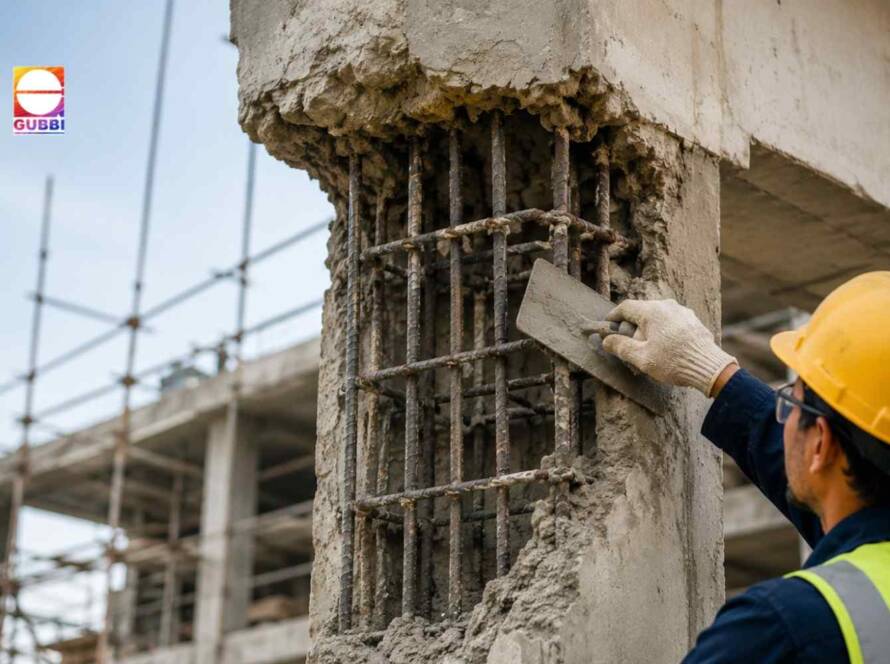
Reinforcement corrosion remains one of the leading causes of structural degradation in reinforced concrete structures.
Continuous exposure to moisture, carbonation, chlorides, industrial chemicals, or aggressive environmental conditions gradually compromises the protective concrete cover, allowing corrosion to initiate.
Typical indicators include:
- Rust staining
- Concrete delamination
- Spalled concrete
- Exposed reinforcement
- Hollow sounding concrete
- Loss of concrete cover
If not addressed promptly, corrosion significantly reduces the structural capacity of RCC members and accelerates deterioration.
Professional rehabilitation generally includes concrete restoration, reinforcement treatment, corrosion mitigation systems, structural strengthening, and protective coating applications.
3. Declining Load-Carrying Capacity
Many existing structures continue to operate under loading conditions that exceed their original design assumptions.
Common scenarios include:
- Installation of heavy industrial equipment
- Additional production machinery
- New mezzanine floors
- Increased storage loads
- Solar panel installations
- Expansion of operational facilities
Without structural strengthening, these modifications may overstress critical structural members.
Building Retrofitting Services restore structural adequacy through engineered strengthening systems designed to safely accommodate revised loading requirements.
4. Excessive Structural Deflection
Visible deflection in beams, slabs, or structural framing often indicates loss of stiffness or excessive loading.
Common observations include:
- Sagging floor slabs
- Deflected beams
- Uneven flooring
- Ceiling deformation
- Misaligned partitions
- Doors and windows that no longer operate correctly
Structural deflection should never be treated as an aesthetic issue. It frequently represents a reduction in structural performance requiring detailed engineering evaluation.
5. Persistent Water Ingress
Water intrusion is one of the most destructive factors affecting reinforced concrete structures.
Continuous moisture penetration accelerates:
- Reinforcement corrosion
- Concrete deterioration
- Carbonation
- Sulphate attack
- Structural weakening
- Reduced service life
Buildings experiencing recurring leakage, dampness, or moisture-related deterioration should undergo both structural assessment and rehabilitation to eliminate the underlying causes rather than repeatedly performing cosmetic repairs.
6. Ageing Structural Assets
Buildings constructed several decades ago often experience gradual deterioration due to long-term service exposure.
Age-related structural issues commonly include:
- Carbonation-induced corrosion
- Material fatigue
- Reduced concrete durability
- Reinforcement degradation
- Surface weathering
- Loss of structural efficiency
Periodic structural assessments help identify deterioration before it develops into major rehabilitation requirements.
7. Earthquake Vulnerability
Numerous buildings were designed before the implementation of current seismic design provisions.
Older structures may exhibit:
- Inadequate confinement reinforcement
- Weak beam-column joints
- Soft-storey configurations
- Insufficient lateral resistance
- Poor ductile detailing
Professional seismic retrofitting significantly improves structural resilience while reducing potential damage during seismic events.
8. Repeated Structural Repairs
Recurring maintenance is often an indication that the underlying structural problem remains unresolved.
Repeated repairs involving:
- Crack filling
- Concrete patching
- Plaster replacement
- Waterproofing repairs
- Corrosion treatment
may temporarily improve appearance but rarely address the root structural deficiency.
Building Rehabilitation Services focuses on eliminating the source of deterioration through permanent engineered solutions.
9. Foundation Settlement
Foundation movement can affect the performance of the entire structure.
Observable symptoms include:
- Differential settlement cracks
- Uneven floors
- Tilting walls
- Misaligned openings
- Structural distortion
Early structural intervention minimizes further damage and significantly reduces long-term rehabilitation costs.
10. Functional Change of the Building
When a building’s occupancy or operational requirements change, its structural demands also change.
Examples include:
- Industrial conversion
- Commercial redevelopment
- Warehouse expansion
- Healthcare facility upgrades
- Educational infrastructure modernization
Professional Retrofitting Services ensure that the existing structure safely supports revised operational requirements while complying with applicable engineering standards.
Engineering Solutions Used in Professional Retrofitting Services
Following a comprehensive structural condition assessment, engineers may recommend one or more specialized strengthening techniques depending on the condition of the structure.
These include:
- RCC Structural Jacketing
- Column Jacketing
- Beam Strengthening
- Slab Strengthening
- Carbon Fiber Reinforced Polymer (CFRP) Strengthening
- Steel Plate Bonding
- Epoxy Injection Grouting
- Micro Concrete Rehabilitation
- Foundation Strengthening
- Structural Crack Repair
- Concrete Restoration
- Seismic Retrofitting
- Protective Anti-Corrosion Systems
Each rehabilitation strategy is developed based on structural analysis, loading requirements, durability objectives, and the expected service life of the asset.
Why Early Structural Retrofitting is a Strategic Investment?
Timely retrofitting delivers measurable technical and financial benefits throughout the asset lifecycle.
Key advantages include:
- Restoration of structural integrity
- Enhanced load-bearing capacity
- Improved seismic performance
- Extended service life
- Reduced maintenance expenditure
- Improved operational reliability
- Compliance with current structural standards
- Increased asset value
- Lower lifecycle costs
- Sustainable alternative to demolition and reconstruction
An experienced Building Rehabilitation company follows a systematic methodology comprising structural investigation, condition assessment, non-destructive testing (NDT), engineering analysis, repair design, material selection, and precision execution to restore the structural performance of ageing or distressed assets.
Whether addressing deterioration caused by corrosion, excessive loading, environmental exposure, seismic deficiencies, or ageing infrastructure, professionally engineered retrofitting solutions ensure long-term structural reliability, operational safety, and enhanced asset performance.
Conclusion
Structural deterioration rarely occurs suddenly. Most failures are preceded by identifiable warning signs that, when addressed early, can prevent extensive damage and significantly reduce rehabilitation costs.
If your facility is experiencing structural cracking, corrosion, excessive deflection, water ingress, ageing-related deterioration, or changing operational requirements, engaging an experienced Building Retrofitting Services provider is the most effective approach to preserving structural integrity and extending the useful life of your asset.
Through technically engineered Building Rehabilitation Services, organizations can strengthen existing structures, improve operational safety, ensure regulatory compliance, and maximize long-term return on infrastructure investments.