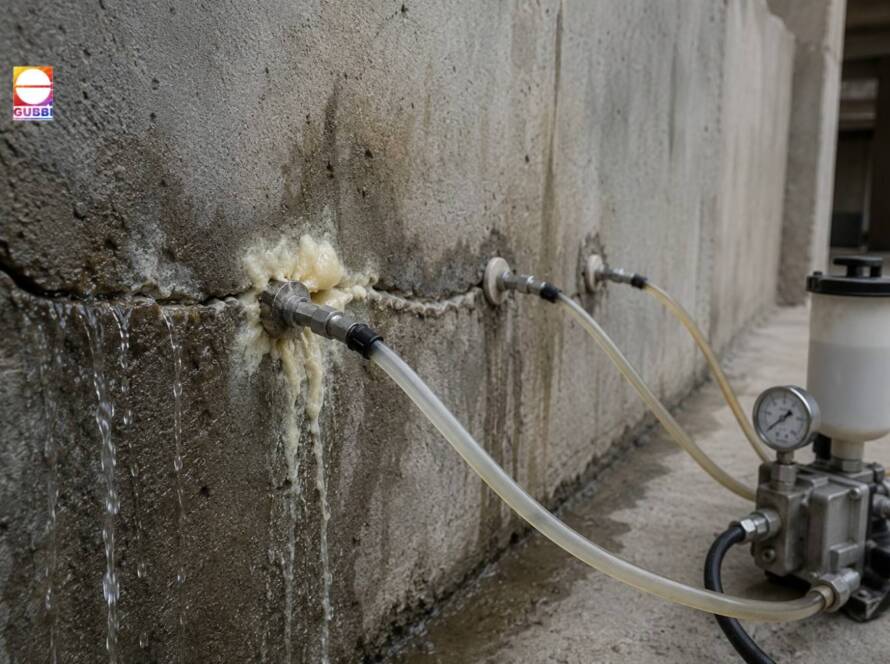

Epoxy Injection Grouting plays a critical role in repairing structural cracks and restoring the strength of reinforced concrete (RCC) members in commercial and industrial buildings. Although these structures are engineered for long-term performance, continuous operational loads, heavy machinery vibrations, environmental exposure, ageing of concrete, reinforcement corrosion, construction defects, and water ingress gradually affect their structural integrity. If left untreated, these conditions can lead to progressive deterioration, making timely structural repair essential for ensuring safety, durability, and uninterrupted operations.
One of the earliest indicators of structural deterioration is the appearance of cracks. While some cracks may seem minor, structural cracks often indicate underlying issues that require professional engineering evaluation rather than cosmetic repairs.
As part of a comprehensive building rehabilitation strategy, Epoxy Injection Grouting is a proven structural repair technique used to restore the integrity of cracked RCC members without replacing the existing structure. Restoring structural continuity, it helps improve durability, extend service life, and preserve valuable commercial and industrial assets.
Why Structural Cracks Should Never Be Ignored?
Structural cracks create direct pathways for moisture, oxygen, chlorides, and industrial contaminants to penetrate reinforced concrete. Over time, this accelerates reinforcement corrosion, weakens the bond between steel and concrete, and reduces the durability of the structure.
If left untreated, structural cracks in commercial and industrial buildings may lead to:
- Reduced load-carrying capacity
- Progressive concrete deterioration
- Reinforcement corrosion
- Water seepage into occupied spaces
- Increased maintenance costs
- Operational disruptions
- Premature structural rehabilitation or strengthening requirements
The objective of building rehabilitation is not simply to seal visible cracks but to restore structural integrity and prevent further deterioration.
Role of Epoxy Injection Grouting in Building Rehabilitation
The epoxy injection grouting method is used to restore monolithic action in dormant structural cracks within RCC members.
A specially formulated low-viscosity structural epoxy is pressure injected through engineered injection ports, allowing the resin to penetrate the full depth of the crack. Once cured, the epoxy develops a high-strength bond that reconnects the separated concrete sections, enabling the member to perform as a single structural element.
Instead of replacing beams, slabs, columns, or walls, epoxy injection allows rehabilitation engineers to retain the existing structure while restoring its structural performance.
Applications of Epoxy Injection Grouting in Commercial and Industrial Buildings
Epoxy Injection Grouting is widely used as part of commercial and industrial building rehabilitation projects, including:
- Industrial manufacturing plants
- Commercial office buildings
- Warehouses and logistics parks
- Shopping malls
- Hospitals and healthcare facilities
- Educational institutions
- Hotels and hospitality buildings
- IT parks and corporate campuses
- Power plants
- Pharmaceutical facilities
- Food processing industries
- Water treatment plants
- Multi-level parking structures
- RCC framed buildings
- Infrastructure and public utility buildings
The technique is particularly beneficial where demolition is impractical and uninterrupted building operations are essential.
Benefits of Epoxy Injection Grouting in Building Rehabilitation
When incorporated into a professionally engineered rehabilitation programme, Epoxy Injection Grouting offers several long-term benefits:
- Restores structural continuity of cracked RCC members
- Improves load transfer across structural cracks
- Reduces water ingress and chemical penetration
- Protects embedded reinforcement against further corrosion
- Extends the service life of existing structures
- Minimises disruption compared to structural replacement
- Reduces long-term lifecycle maintenance costs
- Preserves valuable commercial and industrial assets
- Supports sustainable rehabilitation by avoiding unnecessary demolition
Conclusion
Structural cracks are often the first visible signs of deeper deterioration within reinforced concrete buildings. Addressing them through an engineered rehabilitation approach can significantly improve structural reliability, minimise future maintenance, and extend the operational life of commercial and industrial assets.
As an integral part of modern building rehabilitation, Epoxy Injection Grouting restores structural continuity, enhances durability, and helps preserve existing RCC structures. When combined with detailed structural assessment and expert execution, it provides a reliable and cost-effective solution for repairing structural cracks while extending the service life of commercial and industrial buildings.
If your commercial or industrial building is showing signs of structural cracking, water ingress, or concrete deterioration, a professional structural assessment is the first step toward a durable repair solution.