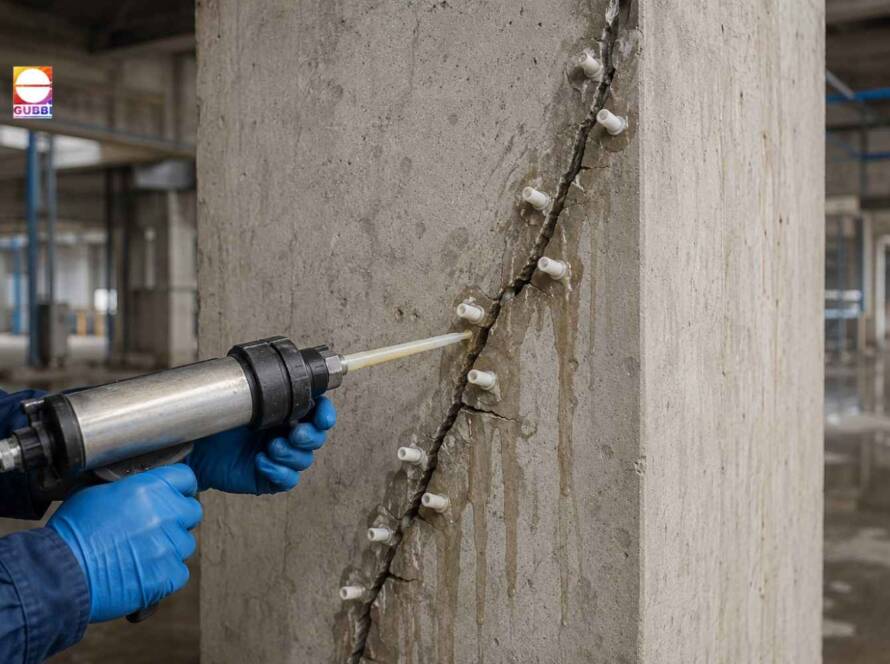


PU Injection Grouting is one of the most effective structural rehabilitation techniques for stopping active water leakage in reinforced concrete (RCC) buildings. By injecting polyurethane resin into leaking cracks, construction joints, and voids, the material expands on contact with water to seal leakage paths from within the concrete, eliminating the need for extensive demolition.
In building repair and rehabilitation projects, controlling water ingress is often the first step before undertaking structural repairs or strengthening. Persistent seepage through basements, lift pits, underground structures, and RCC walls accelerates reinforcement corrosion, concrete deterioration, and the premature failure of repair systems. When selected based on proper engineering assessment, PU Injection Grouting provides a reliable solution for restoring watertightness and creating suitable conditions for long-lasting rehabilitation works.
Why Water Leakage Should Be Addressed First?
Moisture entering RCC members creates conditions that promote corrosion of embedded reinforcement. As corrosion progresses, rust expands, causing cracking, delamination, and concrete spalling.
Repairing damaged concrete without eliminating the source of water ingress often results in recurring failures. Therefore, rehabilitation projects should begin with identifying and sealing active leakage before proceeding with structural repairs.
Where PU Injection Grouting is Used?
PU Injection Grouting is widely used in rehabilitation projects involving:
- Basements and retaining walls
- Lift pits
- Underground water tanks
- Construction joints
- Expansion joints
- Roof slabs with leakage
- Podium slabs and parking structures
- Pipe penetrations and service entries
It is particularly effective where water continues to seep under hydrostatic pressure.
How PU Injection Grouting Works?
The process involves injecting polyurethane resin through packers installed along the leakage path. When the resin comes into contact with water, it expands to fill cracks, voids, and interconnected pores, creating a watertight seal.
Unlike surface waterproofing methods, injection grouting seals the leakage path internally, making it suitable for locations where external access is limited or excavation is impractical.
Engineering Assessment Before Injection
Not every leaking crack requires PU injection. Before selecting the repair method, engineers assess:
- Source of water ingress
- Crack pattern and condition
- Construction or expansion joints
- Concrete quality
- Groundwater pressure
- Whether the crack is structural or non-structural
If structural distress is identified, additional rehabilitation methods such as epoxy injection groiuting, concrete repair, or structural strengthening may also be necessary.
Benefits of PU Injection Grouting
When executed correctly, PU Injection Grouting offers several advantages:
- Stops active water leakage quickly
- Requires minimal demolition
- Suitable for inaccessible areas
- Seals fine cracks and internal voids
- Reduces disruption to occupied buildings
- Improves the durability of subsequent repair works
These benefits make it a preferred solution for rehabilitation of existing RCC structures.
PU Injection vs Epoxy Injection
Although both are injection-based repair techniques, they serve different purposes.
|
PU Injection Grouting |
Epoxy Injection |
|
Seals active water leakage |
Restores structural integrity of cracks |
|
Used for waterproofing |
Used for structural crack repair |
|
Performs in wet conditions |
Best suited for dry cracks |
|
Flexible after curing |
Rigid, high-strength bond |
Selecting the correct material depends on the nature of the defect rather than the crack alone.
PU Injection as Part of Building Rehabilitation
PU Injection Grouting is most effective when integrated into a comprehensive building rehabilitation programme. After leakage is controlled, additional repair measures may include concrete restoration, corrosion treatment, protective coatings, or structural strengthening, depending on the condition of the building.
An engineering-led approach ensures that both the symptoms and the underlying causes of deterioration are addressed, resulting in longer-lasting rehabilitation outcomes.
Conclusion
PU Injection Grouting is a proven technique for controlling active water leakage in RCC buildings and underground structures. By sealing leakage from within the concrete, it helps protect structural components from continued moisture exposure and provides a reliable foundation for further building rehabilitation and renovation works.
For long-term performance, the repair method should always be based on a detailed structural assessment and executed by experienced rehabilitation specialists. When used as part of a well-planned building rehabilitation strategy, PU Injection Grouting contributes significantly to extending the service life and durability of existing concrete structures.